
I didn't set out to open a bakery.
For most of my twenties, I was trying to answer a different question entirely: in a world where most people have never seen where their food comes from, how do you make them care?
I grew up in Hong Kong — a city that imports over 90% of its food. The connection between what arrives on your plate and where it actually comes from is a distance most people never think to cross. Moving to the Netherlands to study at Design Academy Eindhoven slowly changed that.
In my second year, I walked into a slaughterhouse for the first time.
I watched a cow being killed. I remember the eyes. I remember the stun gun, and how small the person holding it looked next to the animal, and how there was nowhere to go. The whole thing was over in seconds. And I stood there thinking: if people could see this, would they still eat the same way?
That question became the origin of everything I did through my university years and beyond. I went to Indonesia and lived with traditional communities for three months, trying to understand cultures where the relationship between people and animals was still intact. I worked on an organic farm in Eindhoven, learning to milk cows, understanding what a life in dairy actually looks like. Eventually I bought a cow — a Dutch dairy cow named Romie 18 — and followed her from farm to slaughter, turning her bones and hide into objects.
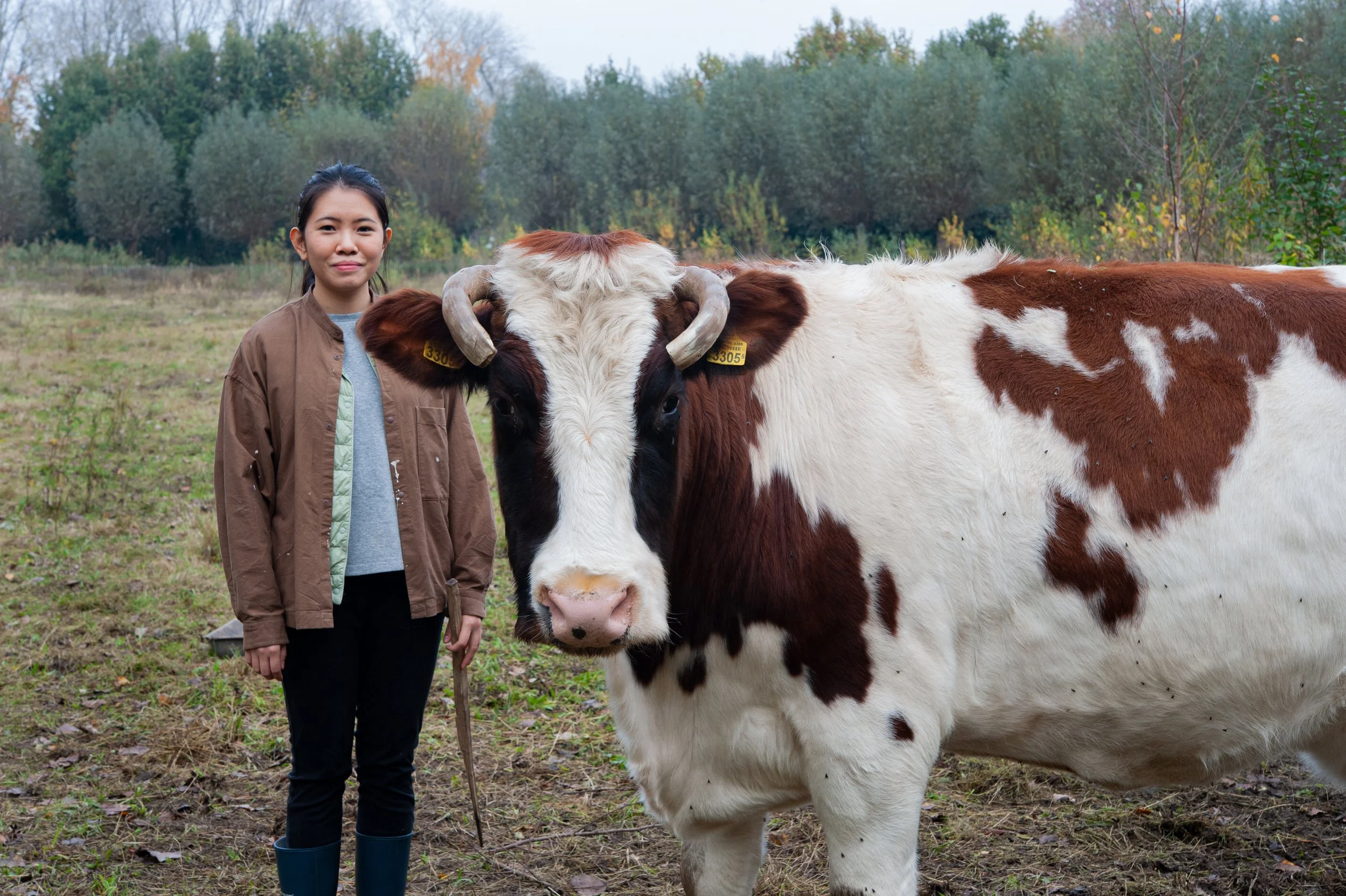
me and Romie 18.
I enjoyed working close to the source — doing field research, setting up on-site observations, sitting with complexity until something essential emerged. Through food experiences, objects, and stories, I translated the nuances of our relationship with food into something accessible. My goal was to help people reconnect to where their food actually comes from, so they could make more conscious choices about what ends up on their plate.
The work found its audience — and I was grateful for that. But what had always excited me was never the exhibition wall. It was the moment food passed someone's lips — something tasted rather than observed from a distance. I wanted to find a way to reach people more directly.
I wanted to find a different way in.
Around this time, a friend bought a cake.
It was a chocolate cake — fully vegan, gluten-free, made by someone she knew. She brought it over and I tried a slice, fully expecting it to taste like a compromise. It was dense and dark and deeply chocolatey. I was genuinely surprised.
A few months later, I was walking through Oogstmarkt — a farmers and makers market in Rotterdam — and I spotted an Asian woman selling cakes from a small stall. Something clicked. I walked over and introduced myself.
Her name was Alice. She was the one who had made that chocolate cake.
We started talking. The cakes were already there — honest, good, made with rice flour and naturally gluten-free, without compromising on flavour or texture. Alice moved into a pop-up inside Market Hall for three months. I'd pass her stall every time I went to the supermarket. I wanted to help her — to build the brand in a way that was more beautiful, more true to who she was, so that people could actually see the value of what she was making. We kept talking. The conversations got longer and went deeper, into what we each actually wanted to build, and why.
Then came Object Rotterdam, a design fair where I was invited to create a booth. Not just to exhibit, but to sell — food and drinks as a designed experience, something you could taste and take home. I developed a cake concept for the occasion and asked Alice to produce it.
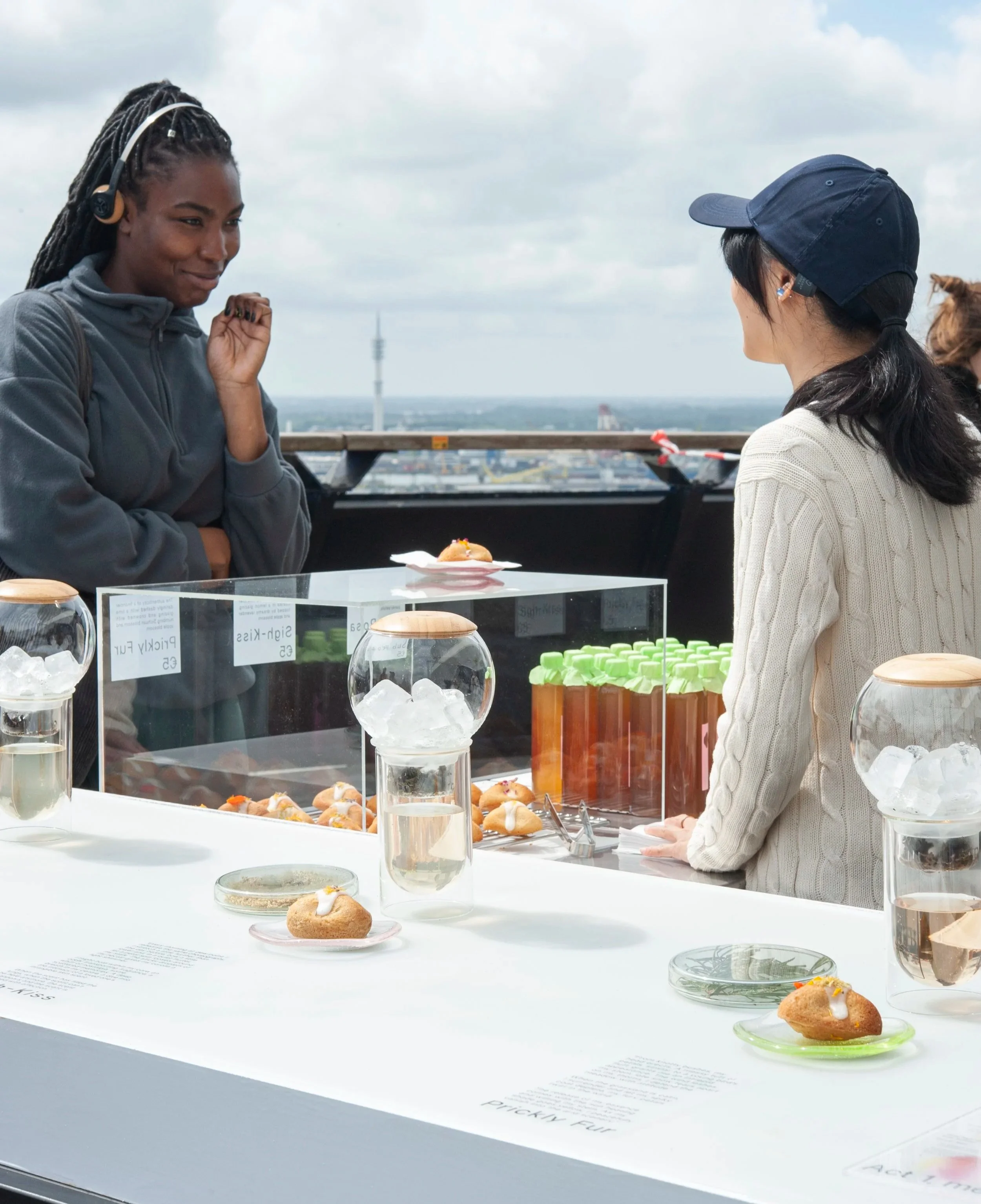
Cake and Drink curation for Object Rotterdam
She was getting married that week.
She baked the cakes the day before and after her wedding.
I was moved. She was going through one of the biggest moments of her life, and she still showed up completely committed, careful, without complaint. That kind of dedication is rare. I had long wanted to open a restaurant — to use food as a vehicle for telling stories, for making people feel differently about what they eat. Alice had been dreaming of a café, a space where her cakes could have a proper home. We decided to build something together.
We started at Oogstmarkt — this time as NOiAA, a name we had chosen together for what we were building. Every weekend for a year, we ran the stall, testing the ground before committing to a space. We learned what people responded to, which flavours connected, and how to talk about rice flour to someone who had never thought about it. We got better at working together.
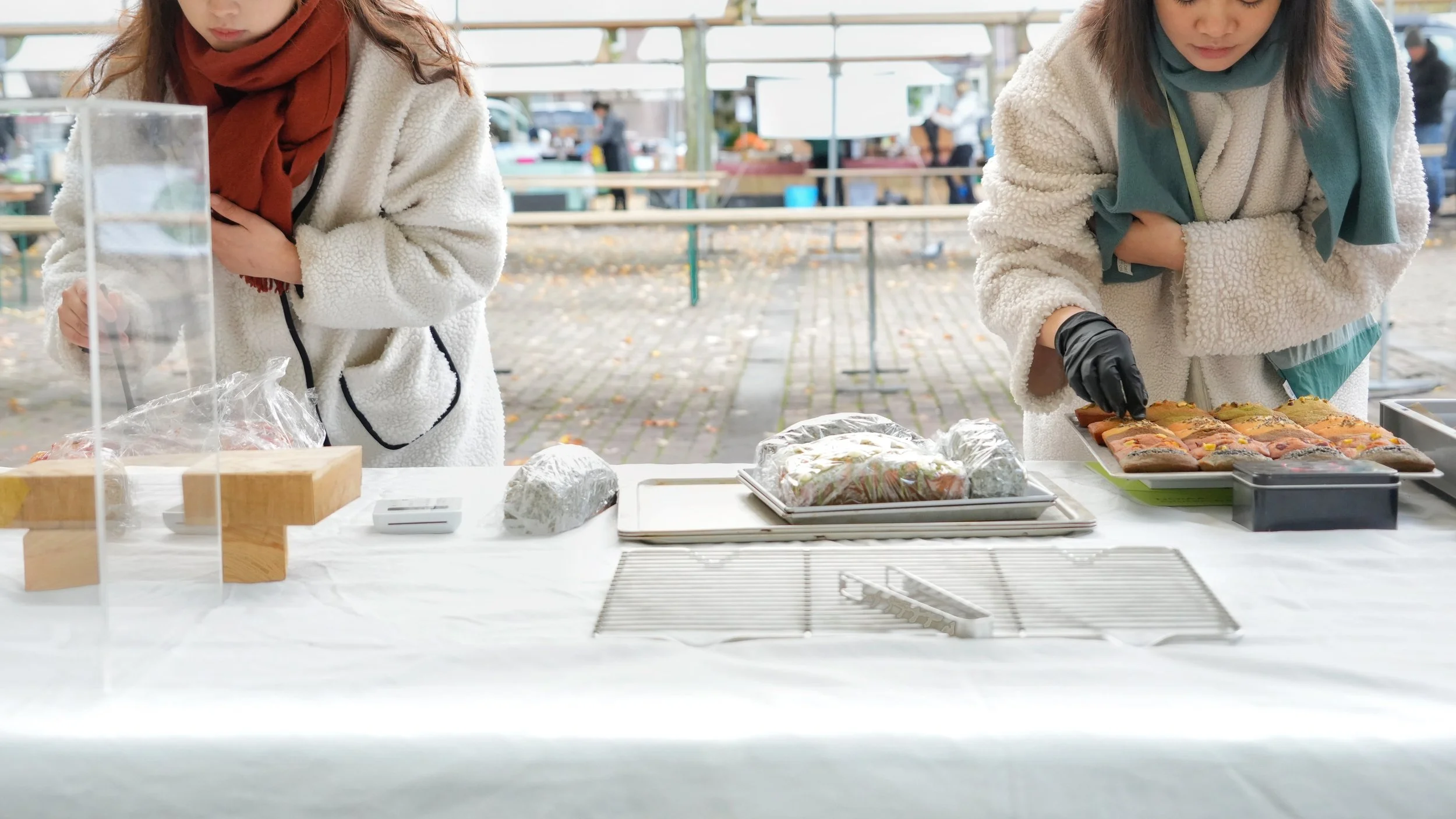
Preperation in Oogstmarkt.
Then we found the space.
Pannekoekstraat 99A is a small, light-filled corner on a quiet street in the centre of Rotterdam. When we saw it, we both knew.
We opened NOiAA in the spring of 2024.
My role at NOiAA has been something like a creative director — responsible for the way the space looks and feels, for finding the objects and details that belong inside it, for the visual identity, social media, the aesthetics of how the cakes are decorated and packaged, the weekly flowers, the way food is presented. And also, like any small business, front of house, admin, baking, and everything in between. Building NOiAA unlocked a version of myself I hadn't fully met before.
Two years in, NOiAA has grown into something we didn't entirely predict: a place people genuinely love coming back to. A neighbourhood spot. And, to our own surprise, somewhere that became known for matcha — which still makes us smile.
Alongside the studio, we launched NOiAA Square — an idea we had carried from the very beginning. We always imagined NOiAA as two things at once: a place to share food, and a place to share more than food. We just needed the studio to find its footing first.
By 2025, while we were getting more stable, the second part could finally begin. Wreath workshops, poetry readings, seasonal markets. A shared table for makers, friends, and anyone with something worth bringing to the space.
What it has become — this atmosphere, this feeling when you walk in — is something we built together. And we're not done yet.
Running a small business teaches you things you didn't know you needed to learn. I arrived here as a designer. I stayed as something harder to name — part maker, part operator, part host. It was not the end of my creative practice. It was where it became real.
